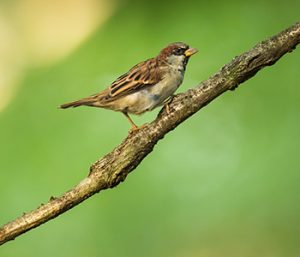
European/House Sparrows
Biology
Females begin egg laying in March and April in the northern United States. They usually lay 5-6 eggs per clutch. The eggs are usually pale greenish white and are always speckled. The eggs hatch after 10-17 days incubation. The young first fly at about 14 days and leave the nest shortly thereafter. There are at least 2 and up to 5 broods each year, but there is an annual natural mortality rate of 40-60% among mature birds which keeps the reproductive potential in check.
Feeding Preferences
They feed mostly on grains and seeds but also on tree and plant buds, sprouting plants, flowers, and small, soft fruits.
Transmitted Diseases
They are of medical concern because there are over 29 diseases and ectoparasites associated with them, their nests and droppings. Diseases include encephalitis, histoplasmosis, Newcastle disease, chlamydiosis, and salmonellosis which can affect human and animal health, and severe cases may result in death.
Habits
House sparrows prefer to nest in protected areas in, or near buildings. Such places include building ledges, gutters, signs, light fixtures, under eaves and bridges, electric power pole cross supports and transformers, and inside warehouses, airport hangers, and stadium roofs. They will also displace other birds, such as robins, wrens, and purple martins, from their nests, destroy the eggs, and use the nest to rear their own. When they do construct nests, they are rather large and flimsy and made of grass, straw, feathers, and other debris. Nests are constructed by both sexes. Sparrows frequently use the same nesting sites over and over.
House sparrows tend to be very territorial, both as individuals and as flocks. They restrict their nesting and feeding sites to specific locations. Sparrows tend to congregate in urban areas during the winter and disperse to rural areas in the spring.
In rural areas they cause considerable damage to crops, such as wheat and sorghum.; Individuals eat up to 0.2 oz per day. Many sparrows feed at cattle feed lots, dairies, and hog and poultry farms where food is abundant. During the breeding season, they feed mostly insects to their nestlings.
They contaminate animal feed during their feeding activities, and their droppings cause defacement of buildings, statues, etc. Their droppings also damage styrofoam insulation found in warehouses, and in hog and poultry-raising facilities. Their nests have caused short-circuits and fires in electrical substations. When they enter malls, department stores, warehouses and food processing plants, they are nuisances and contaminate much with their droppings.
Expert Pest Bird Program
Our service technician will perform a thorough treatment of your structure to locate all problem areas and properly identify the pest you are having.
All programs are specially designed to target the pest that is infesting your structure.
CLICK HERE FOR OUR BIRD PROGRAM
OR
CLICK HERE TO EMAIL US
Memberships & Certifications