Main Office: 1-877-463-9737
Expert Pest Management Exterminator in Western PA and Ohio
  • About Us
  • Why Select An Expert
  • Areas We Service
    • Northeast Ohio
      • Boardman
      • Independence (Cleveland)
      • Tallmadge (Akron)
      • Canton
    • Western Pennsylvania
      • Pittsburgh
      • Erie
  • Services
    • Ant Program
    • Bat Program
    • Bed Bug Program
    • Bee / Wasp / Hornet Program
    • Bird Program
    • Carpenter Ant Program
    • Carpenter Bee Program
    • Chipmunk And Vole Program
    • Cockroach Program
    • Flea Program
    • Fly Program
    • Ladybug/Stink Bug Program
    • Mouse Program
    • Pantry Pest Program
    • Other Household Pest Program
    • Rat Program
    • Spider Program
    • Squirrel Program
    • Termite Program
  • Leave a Review
    • PENNSYLVANIA
      • Pittsburgh/Ross Park/North Hills
      • Pittsburgh/GreenTree/South Hills
      • Erie
    • OHIO
      • Boardman
      • Canton
      • Independence
      • Talmadge
  • Contact Us
  • Search
  • Menu Menu
  1. Home»
  2. Starlings»

STARLINGS

Biology

Starling bird removal from your home by experienced animal control service expert at Expert Pest Management.

First brought to North America by Shakespeare enthusiasts in the nineteenth century, European Starlings are now among the continent’s most numerous songbirds. They are stocky black birds with short tails, triangular wings, and long, pointed bills. These birds are notorious for their abundance and aggressiveness. Covered in white spots during winter, they turn dark and glossy in summer.

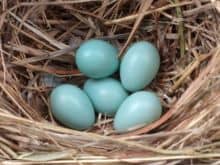
Breeding takes place during the spring and summer. Following mating, the female lays eggs on a daily basis over a period of several days. If an egg is lost during this time, she will lay another to replace it. There are normally four or five eggs that are oval in shape and pale blue or occasionally white, and they commonly have a glossy appearance. Incubation lasts thirteen days, although the last egg laid may take 24 hours longer than the first to hatch. Both parents share the responsibility of caring for the eggs, but the female spends more time incubating them than does the male, and is the only parent to do so at night when the male returns to the nest. The young are born blind and without feathers. They develop light fluffy down within seven days of hatching and can see within nine days. Once the chicks are able to regulate their body temperature, about six days after hatching, the adults stop removing droppings from the nest.

The average life span is about 2–3 years

Feeding Preferences

The common starling is largely insectivorous and feeds on both pest and other arthropods. The food range includes spiders, crane flies, moths, mayflies, dragonflies, damsel flies, grasshoppers, earwigs, lacewings,
caddisflies, flies, beetles, sawflies, bees, 
wasps and ants.

Common starlings can eat and damage fruit in orchards such as grapes, peaches, olives, currants and tomatoes or dig up newly planted crops.

Transmitted Diseases

Starlings droppings can contain the fungus Histoplasma capsulatum, the cause of histoplasmosis in humans. At nesting sites, this fungus can thrive in accumulated droppings. There are a number of other infectious diseases that can potentially be transmitted by common starlings to humans.

Habits

Males choose the nest site and use it to attract females. The nests are always in a cavity, typically in a building or other structure. Nests can be built in as little as 1-3 days.

Starlings signal agitation by flicking their wings, or by staring at their opponents while standing erect, fluffing their feathers, and raising the feathers of the head.

Starlings are strong fliers that can get up to speeds of 48 mph.

Starlings are great vocal mimics: these birds can learn the calls of up to 20 different species. Birds whose songs starlings copy include the Eastern Wood-Pewee, Killdeer, Meadowlarks, Northern Bobwhite, Wood Thrush, Red-tailed Hawk, American Robin, Northern Flicker, and many others.

Starling Removal

 All programs are specially designed to target the pest that is infesting your structure.

CLICK HERE FOR OUR BIRD PROGRAM

OR

CLICK HERE TO EMAIL US

Contact Expert Pest Management

Now Call The Experts At 877-463-9737
If Not An Emergency You May Contact Us VIA E-mail by Clicking Here

Office Hours

Office Hours:
8:00 – 5:30 Mon-Wed, Fri
8:00 – 5:00 Thu
9:00 – 5:00 Sat


PA Offices

Expert Pest Management – Pittsburgh
506 McKnight Park Dr Suite A
Pittsburgh, PA 15237
412-364-8003

Pittsburgh Pest Control Info >


Expert Pest Management – Erie
1001 State St., Suite 1400
Erie, PA 16501
814-454-1377

Erie Pest Control Info >

Ohio Offices

Expert Pest Management – Boardman
135 Marwood Circle
Boardman, OH 44512
330-629-6488

Boardman Pest Control Info >


Expert Pest Management – Tallmadge (Akron)
835 Southeast Ave, Suite # 11
Tallmadge, OH 44278
330-633-2244

Tallmadge Pest Control Info >


Expert Pest Management – Canton
116 Cleveland Ave. NW #555
Canton, OH 44702
330-456-6860

Canton Pest Control Info >


Expert Pest Management – Independence
6100 Oak Tree Blvd Suite 200, Independence, OH 44131
216-295-0232

Independence Pest Control Info >

Memberships & Certifications

Expert Pest Management is a member of the National Pest Management Association
OPMA | Expert Pest Management
OPMA member | Expert Pest Management
Sentricon Certified specialist - Expert Pest Management
West Virginia Pest Management Association
Expert Pest Management is a member of the Pennsylvania Pest Management Association
Youngstown Regional Chamber
© 2009-2026- Expert Pest Management . No portion of this site may be reproduced.
Scroll to top